Chris Do in Cambridge: Masterclass that left people with an actual plan
We’re closing out the year by pulling one last piece from the archive, and we didn’t pick it because it’s the most polished episode or the most cinematic one.
We picked it because it’s brisk, useful, and positively crammed with the sort of good sense one rarely finds in the wild.
The kind of recording where you can feel people leaving the room with a plan. Not a vague “I should post more” plan, but a real, specific, Monday-morning plan.
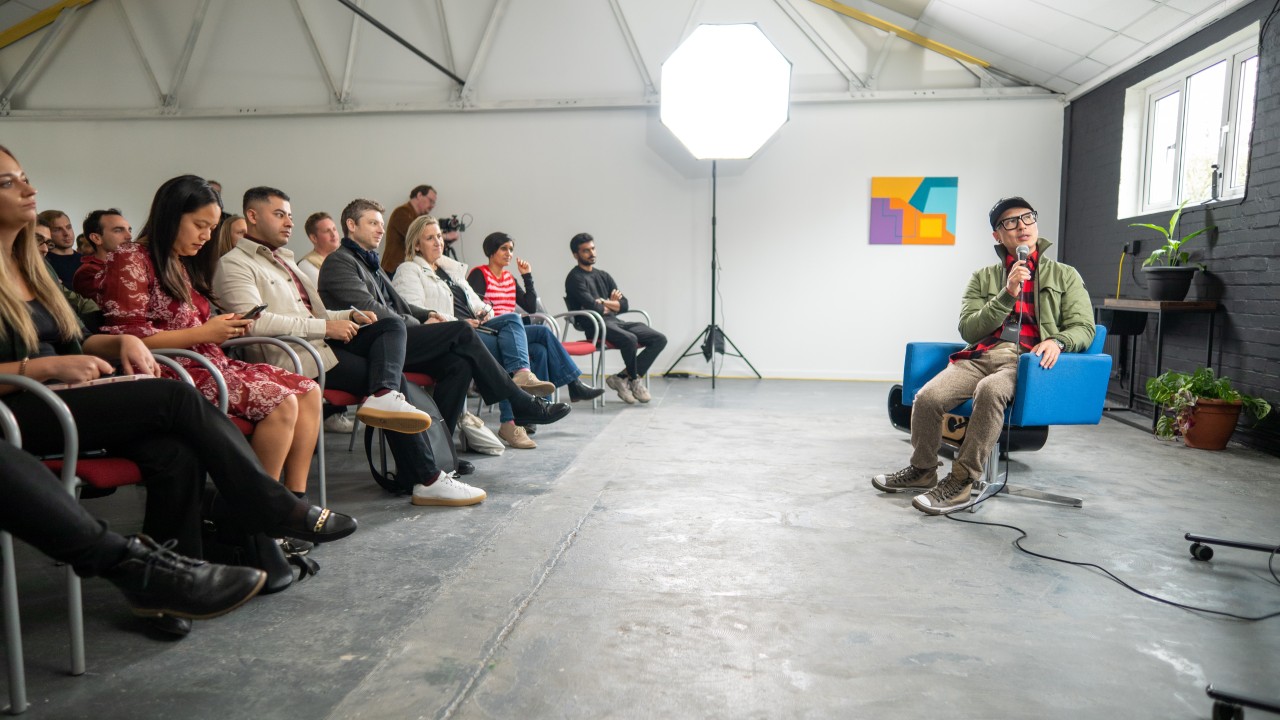
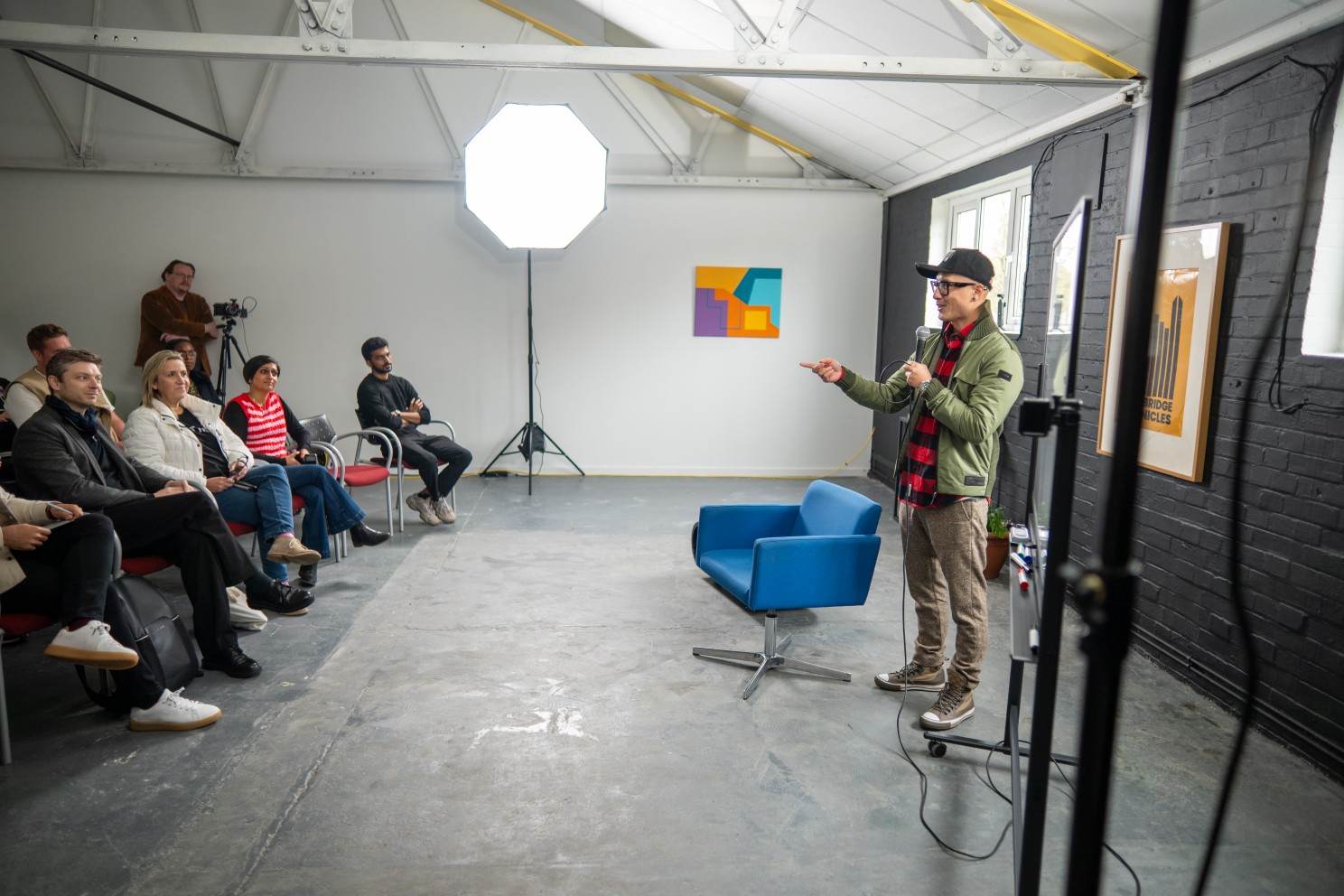
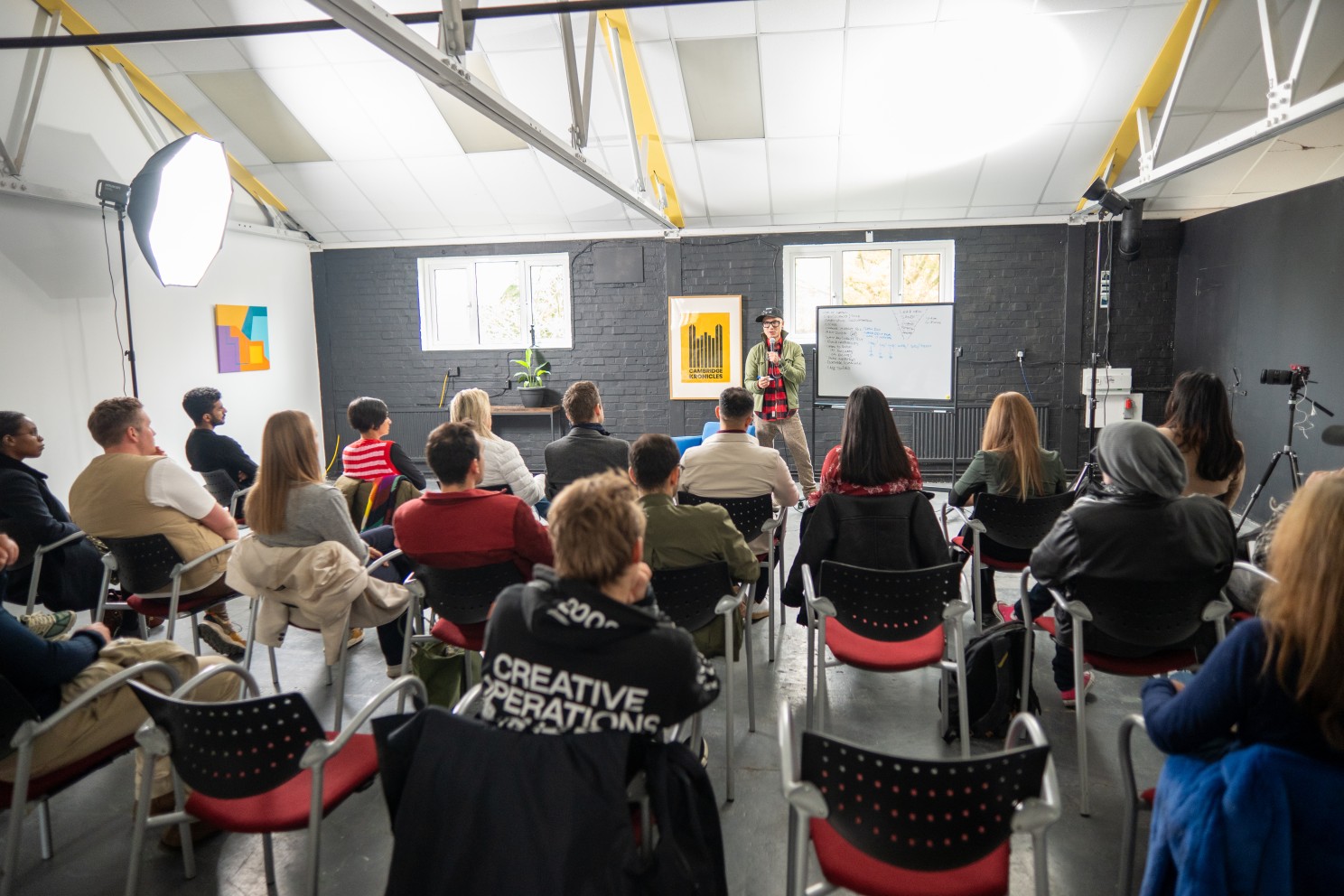
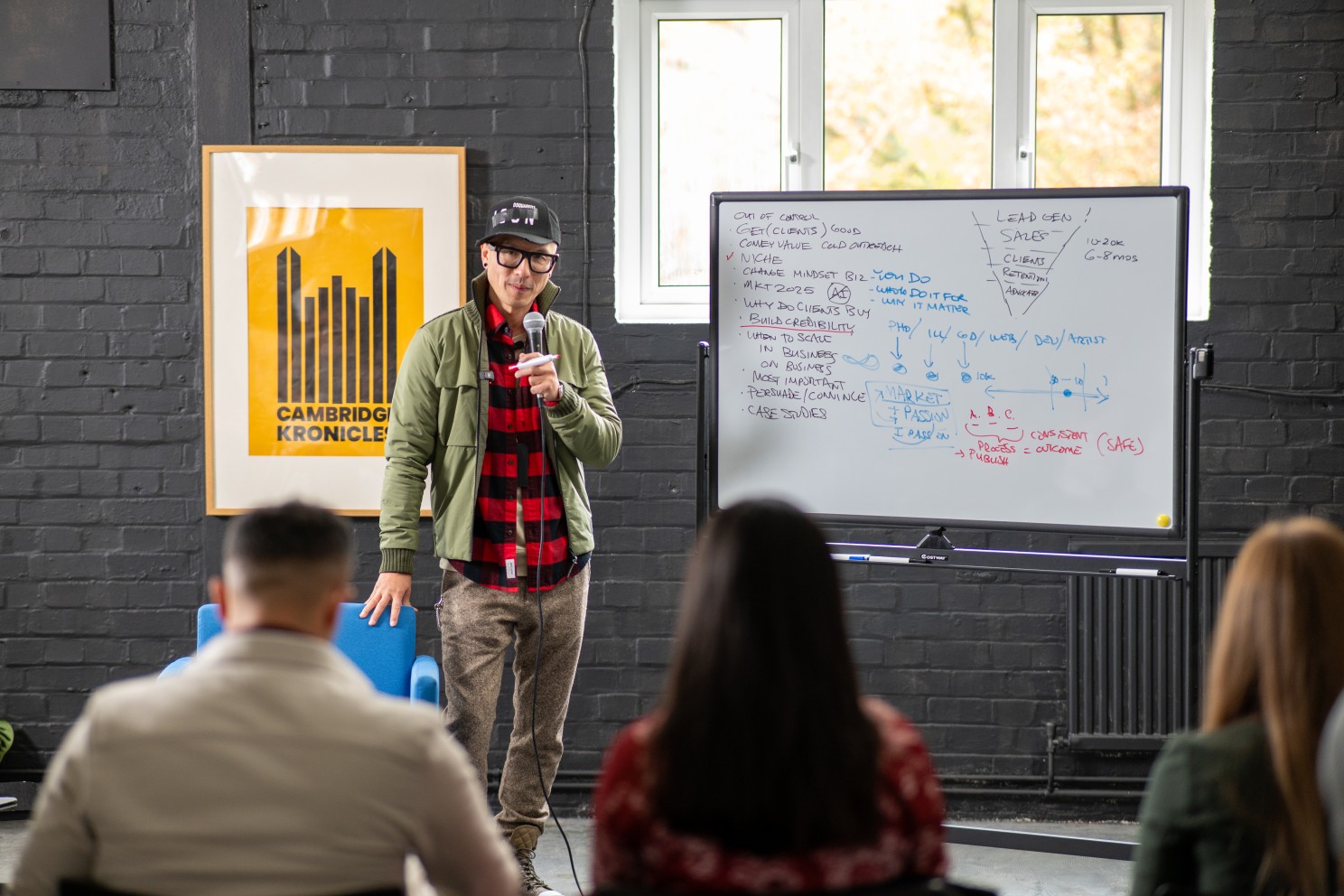
This was a live masterclass with Chris Do in our Cambridge studio. A working session, if you will, with multiple people asking questions as they occurred to them, and Chris helping them hear what they’re actually asking, then answering that.
There’s also a detail worth stating plainly, because it tells you something about the man. Chris came and ran the masterclass for free. In an industry where “generosity” often arrives with a checkout link, that mattered to us.
So here’s our attempt to bottle what happened in that room without flattening it into generic “tips.”
Who Chris is (and why the room went quiet)
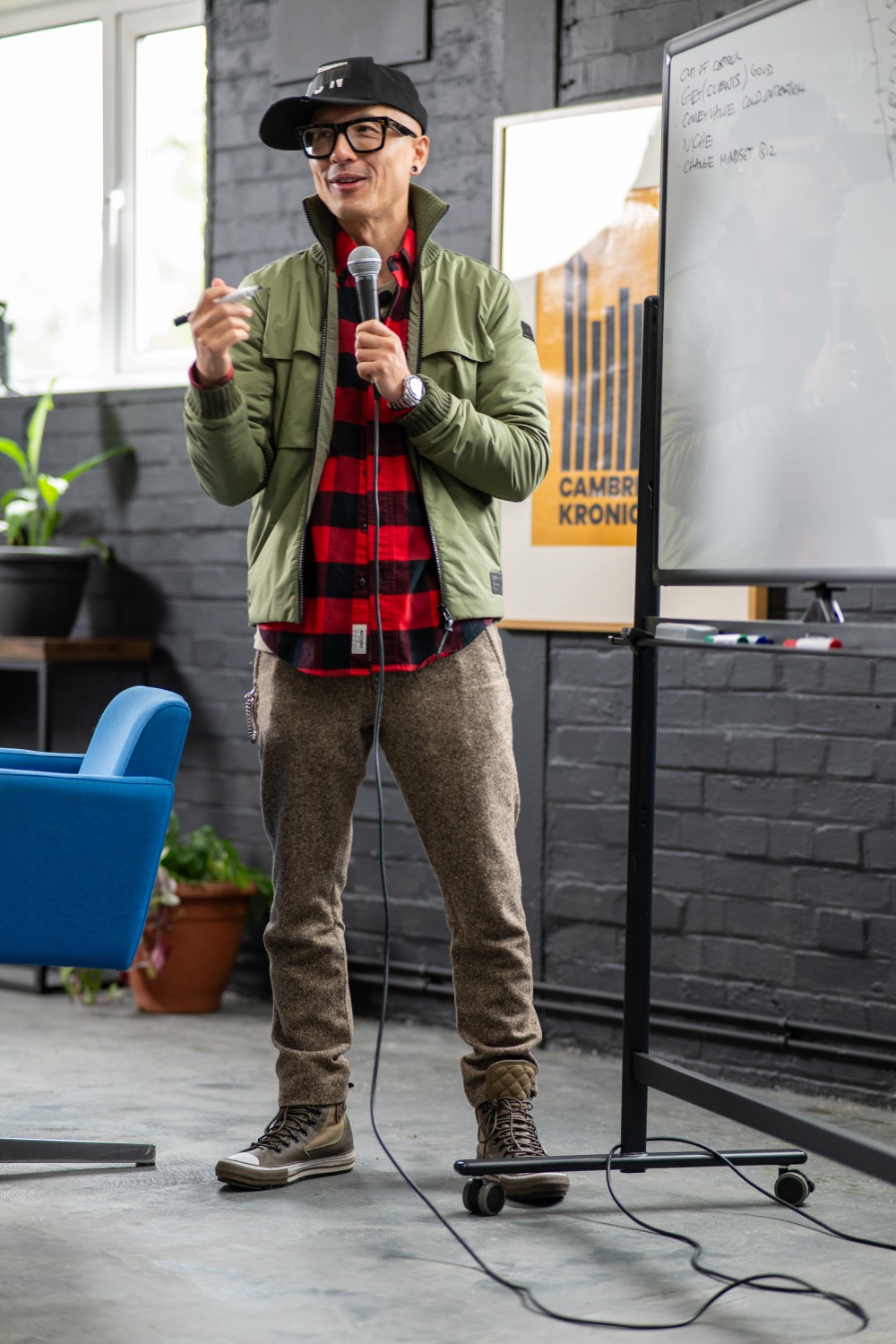
If you work anywhere near design, brand, motion, content, or the slightly unruly overlap between creativity and commerce, you’ve probably crossed paths with Chris Do’s work in one form or another. He’s an Emmy award-winning designer and director, CEO and chief strategist of Blind, and the founder of The Futur—an education platform built around teaching creatives how to stop treating business like an unpleasant vegetable on the side of the plate.
Chris also has a knack for taking a question that arrives as a tangle and returning it as something you can actually do something with. He asks a few clarifying questions, trims away the decorative wording, and gets straight to what a client is deciding when they hire you.
That’s why the room went quiet in Cambridge. Not because he was doing a performance, but because he was listening properly and replying with the sort of precision that leaves you slightly exposed, then oddly relieved.
The theme Chris kept returning to: uncertainty is expensive
The room covered positioning, niche, process, content, lead generation, follow-up, pricing, confidence, and the strange psychology of clients who say they want boldness but behave as though they prefer a warm glass of milk.
Underneath all of it, Chris circled back to one very crisp yet profound through-line.
Reduce uncertainty—for the client, and for yourself:
- Clients feel uncertain about outcomes, process, timelines, internal approval, and risk, so they squeeze budgets, delay decisions, or pick “safe” suppliers they don’t love.
- Creatives feel uncertain about their positioning, their niche, their sales process, and their content strategy, so they default to broad messaging and sporadic marketing, then blame the algorithm when nothing sticks.
Everything he taught that day is a way of lowering that uncertainty.
Here’s how that broke down.
1) Clarity is not a branding detail
One of the most useful moments in the room was Chris insisting that the basics are not optional, even if you’re experienced:
“You have to know what you do, who you do it for, and why it matters.”
That sounds obvious until you try to say it in one sentence without slipping into vague language, buzzwords, or a list of services. Most people can’t, and it’s rarely because they’re incapable but because they haven’t forced the decision.
The “multi-hyphenate” trap came up too: people describing themselves as a photographer/designer/illustrator/director/editor/strategist, hoping it reads as range. Chris’s point wasn’t that you shouldn’t have multiple skills. It was that you shouldn’t hand the client a sorting problem and expect them to do the work of positioning you.
If a potential client has to pause to interpret you, you’ve introduced friction at the worst possible moment, and friction kills momentum long before your portfolio even has a chance.
The fix is a clearer promise.
2) Positioning is competition reduction
Chris delivered a line that should probably be printed and taped above a desk.
“And the goal of positioning in marketing is to reduce or eliminate competition.”
That’s the job.
Not “sound premium” or “be everywhere.” Reduce the number of people you’re compared against so you stop being interchangeable, because the moment you’re interchangeable, the conversation becomes about price, speed, and availability, and none of those are where creative businesses win long term.
If you’re currently competing with “everyone who does video” or “anyone who designs brands” or “any creative who can build a site,” you’re playing in the noisiest possible category. You might still book work, but it will skew toward clients who shop on cost, treat you like a vendor, and have no loyalty once a cheaper option appears.
Positioning is the opposite of that. It’s choosing a narrower lane so you can build momentum in the lane you’re actually in, rather than drifting between ten lanes and wondering why you never feel established.
In the session, Chris framed it in a way that made it feel less like a marketing trick and more like a practical life choice:
“We’re gonna pick a market, and we’re gonna follow our passion.”
Market plus passion. Not passion alone, because passion without a market is a hobby. Not market alone, because a market without any internal pull tends to burn people out or turn their work into a grind.
You don’t have to pick “one niche forever,” but you do have to pick a niche long enough to get paid properly for the work you’re already capable of doing.
3) Process is part of the product
Creatives love to talk about craft, and clients often say they care about craft, but what clients actually buy is a mix of outcome and risk tolerance. Chris went straight at that, not by telling people to overpromise, but by showing them how to make the work feel safer.
Two lines from the session captured it perfectly:
- “Low variability in process equals low variability in outcome.”
- “Predictable outcomes are valuable because they communicate low risk.”
When you read that slowly, it explains a huge amount of pricing reality.
The reason some people can charge more isn’t because they’re magically more talented; it’s because they’ve built a process that signals repeatability, and repeatability signals safety. Clients will pay more for safety, especially when their reputation is on the line internally and the project is visible to other stakeholders.
Chris pushed people to think beyond the deliverable and toward the experience of getting the deliverable. If the client feels lost for three weeks while you “work your magic,” the perceived risk goes up, even if your final output is excellent. If, instead, the client feels guided, informed, and progressed week by week, the perceived risk drops, and trust rises.
4) “Quick wins” are how you calm the client’s nervous system
One of the most practical parts of the masterclass was the discussion around early momentum. Chris asked variations of the same question: what can you deliver early that gives the client certainty and relief?
This is where “client experience” stops being a nice-to-have and becomes a differentiator that clients actually remember.
Or as Chris explains, it shows that:
- “You’re also communicating to me, ‘This ain’t my first rodeo.’”
- “I’ve done this many, many times before.”
That’s what a quick win does. It’s a signal.
It tells the client you’ve been here before, you know what usually goes wrong, and you’ve designed the process to prevent or reduce those problems. It also makes the client feel cared for early, which is when anxiety tends to spike.
Quick wins look different depending on what you sell, but the principle stays the same. Give the client something early that makes them think, “Okay, this is moving, and I’m not alone in it.”
If you’re in video or production, that might be a short prep video for the client stakeholders who are nervous on camera, a one-page timeline with clear decision points, or early location and framing options that help them visualise the end result. If you’re in brand or design, it might be a simple decision framework for stakeholders, a “what we’re solving” brief they can circulate internally, or early mood direction that’s tied to a business goal rather than taste.
Again, the goal is to reduce uncertainty.
5) Content works when it reads like help
The social media portion of the session landed because Chris refused to pretend that engagement is mysterious.
He described a simple test that most people instinctively recognise, then ignore anyway:
- “We have to pass the smell test, and the smell test goes like this: are you advertising to me?”
- “If it’s an ad, don’t do it.”
People scroll past ads unless they’re already in buying mode, and most of your audience is not in buying mode most of the time. If every post sounds like a pitch, you’ll train people to ignore you even when you finally have something worth saying.
Chris also explained why some posts get read and others die quietly, even when they cover similar topics:
“If you speak in the language that they say out loud or in their head, they’re gonna read your post.”
That line is deceptively important. It’s the difference between writing for your peers and writing for your buyers.
Creative people often default to industry language because it feels precise, or because it signals expertise, but clients don’t live inside your vocabulary. They live inside their own anxieties, deadlines, approvals, and fear of making a visible mistake. When you write in their language, you don’t just become clearer, you become more relevant.
If you’re struggling with content, try this instead of asking “what should I post?”: write down ten sentences your ideal client thinks before they hire someone. Not what they say in meetings, what they think when they’re alone. Then write posts that answer those sentences with specific guidance.
6) Lead gen gets easier when you stop demanding commitment too early
This section of the masterclass was quietly one of the most useful, because it addressed a common mistake: trying to extract too much too soon.
Chris’s advice was simple, and it’s the kind of thing that immediately improves the tone of your marketing:
“Don’t make ’em put in an email. It’s too early.”
In other words, if someone has just discovered you and you’ve offered a resource, don’t punish them for taking you up on it. Deliver the resource cleanly, with minimal friction, and let the relationship develop naturally from there.
If you consistently give useful information and you do it in a way that respects the other person’s time, you’ll build trust faster than any funnel trick. The people who want more will lean in, and when they do, the conversation feels like the next step
7) The part people avoid is usually the part that would fix it
The room laughed at times, because Chris is sharp and the exchanges were honest, but there was also a seriousness underneath it. You could feel how many people were trying to solve business problems with surface-level tactics.
Chris didn’t let anyone stay there:
“Well, it’s the stuff you don’t want to hear, but all I got is medicine. It doesn’t taste that good, but it’ll help you heal.”
That’s why this episode is the one we’re ending the year with. It doesn’t give you “tips.” It gives you the unglamorous actions that change your trajectory: pick a market, clarify your promise, reduce risk through process, deliver early momentum, publish in the client’s language, and build a relationship that doesn’t start with an email gate.
None of that is flashy, but it works, and you can start without permission.
A practical 30-day reset, pulled from the session
If you want to turn this into action, here’s a simple way to use what Chris taught without overwhelming yourself.
Week 1: sharpen the sentence
Write one clear line that says what you do, who it’s for, and why it matters. Strip it until it’s understandable by someone outside your industry, then use it everywhere for a month so you can test it properly.
Week 2: build one risk reducer
Design a short “quick win” you can deliver within the first 24–48 hours of a project. Make it reusable, make it genuinely helpful, and make it something that calms the client rather than impresses your peers.
Week 3: document the work while it’s happening
Turn one current project into a living case study as you go, capturing decisions, constraints, and outcomes. This builds proof without waiting for a perfect “after.”
Week 4: publish in the client’s language
Write four posts that answer four client-thought sentences. Keep the tone direct, specific, and generous, and run Chris’s smell test before you hit publish.
If you do only that, you’ll enter the new year with sharper positioning, a clearer process, more trust signals, and content that reads like help instead of advertising.
Why we’re ending the year with this
Chris didn’t have to come to Cambridge, and he didn’t have to give the session away for free, but he did, and he did it properly. We’re grateful for that, and we’re also grateful for what it reminded us of: the best creative rooms are the ones where people leave more capable than they arrived.
Featured here:
- Chris Do's masterclass on Spotify
- Chris Do's masterclass on YouTube
- Chris Do's instagram
- Chris Do's LinkedIn
- Futur
- Snapshot
- Production studio in Cambridge
All images here are ours.